
When your child is nearsighted, glasses or standard contact lenses can provide clear vision. Myopia management takes an additional step by focusing on helping slow how quickly that nearsightedness progresses.
Pacific Eye Care offers myopia management options for children in Huntington Beach. The right approach depends on your child’s prescription, age, eye health, lifestyle, and individual needs.
How Does Myopia Management Work?
Myopia, or nearsightedness, commonly begins during childhood and may progress as the eyes continue to grow. Higher levels of myopia are associated with an increased lifetime risk of certain eye conditions.
Myopia management uses evidence-based approaches intended to help slow progression. Treatment does not cure myopia or guarantee that your child’s prescription will stop changing.
Regular follow-up is also important. Monitoring allows our optometrists to see how your child’s vision is changing and determine whether their management plan should be adjusted.
Myopia Management Options at Pacific Eye Care Doctors of Optometry
Different treatments approach myopia progression in different ways. After evaluating your child, our team can explain which options may be appropriate and what each would involve.
Ortho-K / Orthokeratology
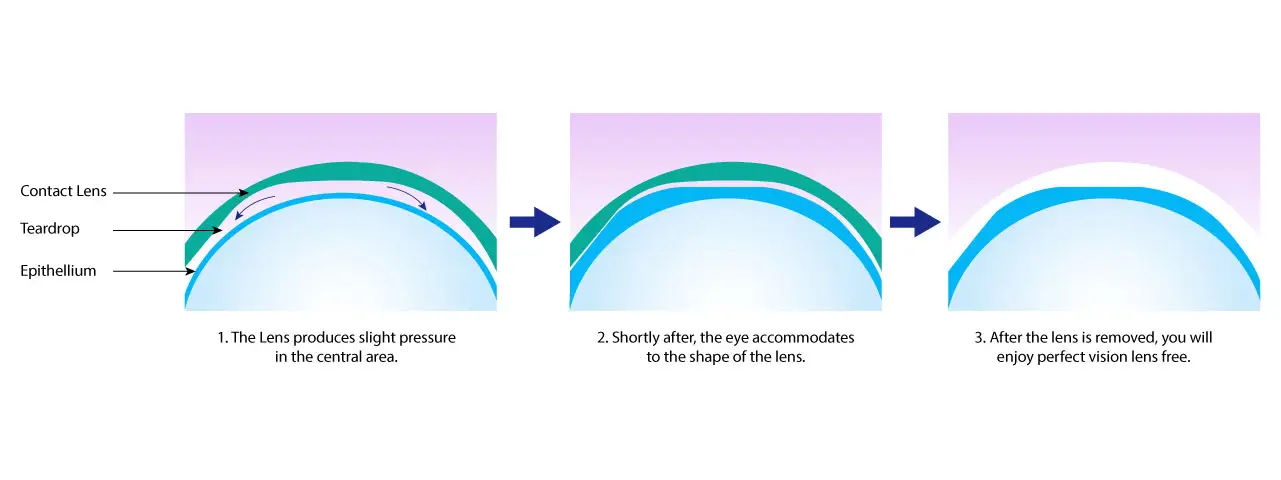
Ortho-K uses customized rigid gas-permeable contact lenses worn overnight. The lenses temporarily reshape the front surface of the eye so that, after removing them in the morning, appropriate patients can see clearly during the day without glasses or daytime contact lenses.
For children with progressive myopia, Ortho-K may also be used as part of a myopia management program to help slow progression.
Successful treatment requires careful fitting, good lens hygiene, and regular follow-up visits.
CTA: Learn About Ortho-K
Low-Dose Atropine
Low-dose atropine eye drops may be considered for some children as part of a myopia management plan.
Because atropine does not correct blurry distance vision on its own, children generally still require appropriate vision correction with glasses or contact lenses.
Whether atropine is suitable, and the concentration and treatment schedule used, should be determined by the prescribing eye care provider based on the individual child.
Myopia-Control Contact Lenses
Specialty soft contact lenses can provide clear vision while also incorporating optical designs intended to help slow myopia progression.
Contact lens suitability depends on more than age alone. Your child needs healthy eyes and must be able to wear, remove, and care for their lenses safely, with appropriate parental support when needed.
Our optometrists can determine whether a myopia-control contact lens is a practical option for your child.